

The deepest and largest underground physics laboratory has begun its work in Sichuan province in southwest China. Located under the mountain at a depth of 2400 meters, the premises and equipment are designed for research. This distance exceeds the height of many volcanoes in Kamchatka.
Scientists believe that in the vast universe, visible matter, which includes particles ranging from a speck of dust to an Earth-like planet or nebula, makes up only about 5 percent of the total mass of the universe. While the remaining 95% consists of dark matter and dark energy.
Due to the extremely low probability of dark matter interacting with visible matter, detecting it directly is extremely difficult. In addition, cosmic rays that permeate the entire Universe could seriously hinder physicists’ efforts to search for dark matter.
Therefore, to successfully detect dark matter and study the Universe, a laboratory with an “ultraclean” space that can protect against cosmic rays and provide an experimental environment with extremely low levels of radiation is required.
This laboratory has become a major world-class project, combining various disciplines, including particle physics, nuclear astrophysics and life sciences. A total of 10 teams from universities and research institutes are stationed there and aim to uncover the secrets of the universe.
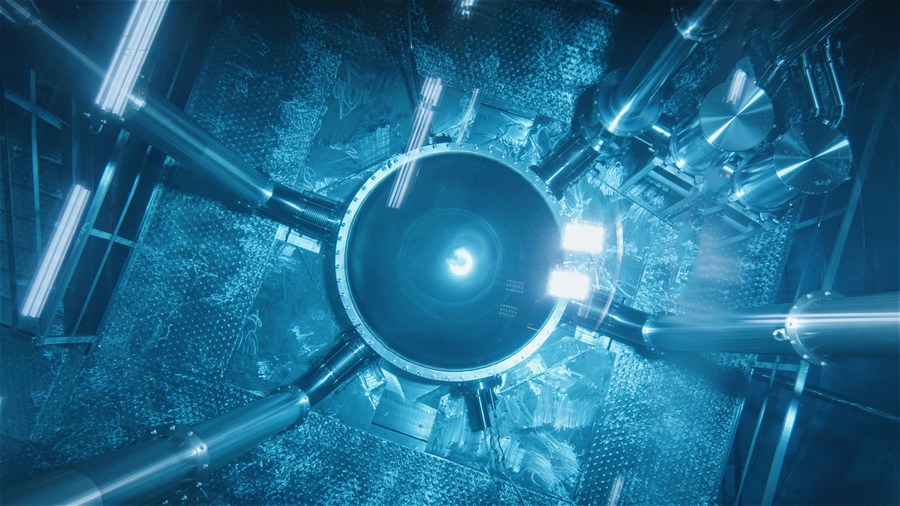
This photo shows the PandaX-4T experimental setup at the second phase of the China Jinping Underground Laboratory in Liangshan Autonomous Prefecture, Sichuan Province, southwest China.