
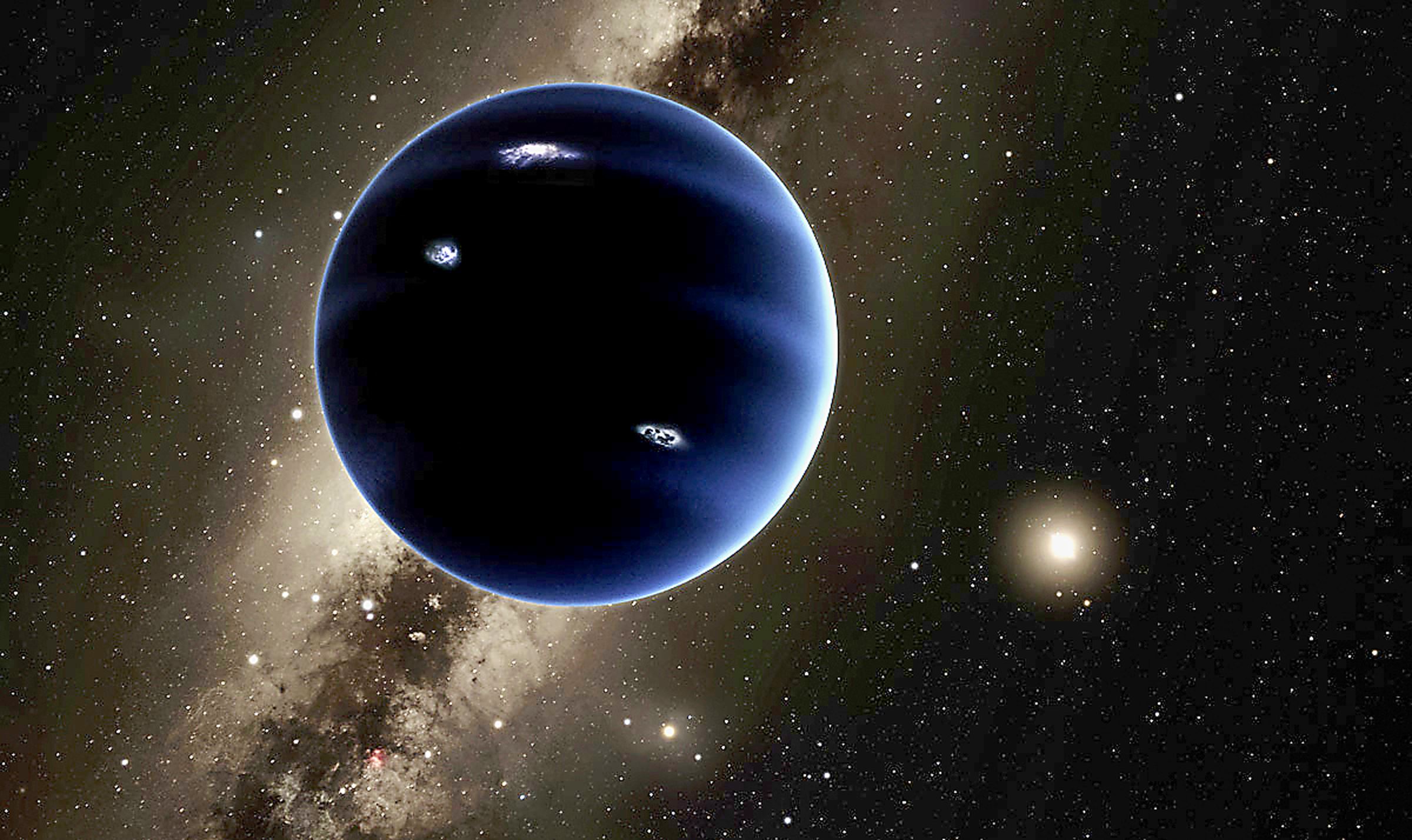
In recent years, evidence has emerged indicating the possible existence of a large, dark object on the outskirts of the solar system, called Planet Nine or Planet X. This discovery could be one of the most exciting events in astronomy, like the discovery of a new continent on Earth. The results of the search for Planet X were published in The Astronomical Journal and summarized in Science News and Nature News.
The solar system, according to the latest definition of the International Astronomical Union (IAU), includes eight planets. The largest of them is Jupiter. In 2006, Pluto was deprived of its planetary status by the IAU because it did not meet one of the established criteria.
The proposed Planet X is comparable in size to Neptune and ten times the mass of Earth. It revolves around the Sun in a highly elongated and inclined orbit with a period of 15 thousand years. Due to the great distance to the outer regions of the solar system, objects there are difficult to detect.
If Planet Nine exists, its orbit should be somewhere between 400 and 800 astronomical units, which is approximately 70 light years. By cosmic standards, it’s just nearby. However, she eluded them.
One possible reason for this could be that Planet Nine is a dark object; like a black hole, for example. Such a black hole would not only not emit any light, it would be extremely small — it would be almost undetectable even if it could reflect light, because, according to calculations, its diameter would be only 9 centimeters.
In a new scientific paper, astronomers discuss the possibility that Planet Nine in our solar system may have moons. Calculations show that it would probably have satellites, since it would have captured an average of 20 objects beyond Neptune’s orbit, each measuring at least 140 kilometers in diameter.
Astronomers have reserved time at Japan’s Subaru Observatory in Hawaii to search for Planet X. In this search they will compete with Trujillo and Sheppard. Confirming the existence of this celestial body could take up to five years. If discovered, the object may be recognized as the ninth planet of the solar system. Previously, the search for Planet X led scientists to the discovery of Neptune (in 1864) and Pluto (in 1930). There is little doubt that the existence of Planet Nine will be confirmed.